


50 Words or Less
The TaylorMade Qi35 Max driver is designed for maximum forgiveness – and delivers strong performance across the face. Powerful, satisfying sound and feel. Fresh new look at address.

Introduction
Nothing excites golfers like new models, and for TaylorMade in 2025 it’s the Qi35 family. The “35” is more than just a higher number to distinguish from the previous Qi10 series. The “3” represents TaylorMade’s three pillars of design: Form, Function, and Fit. The “5” represents the five driver models intended to offer options for the full spectrum of golfers. In this review I’ll dive into the details of the TaylorMade Qi35 Max driver – the most forgiving model in the lineup.

Looks
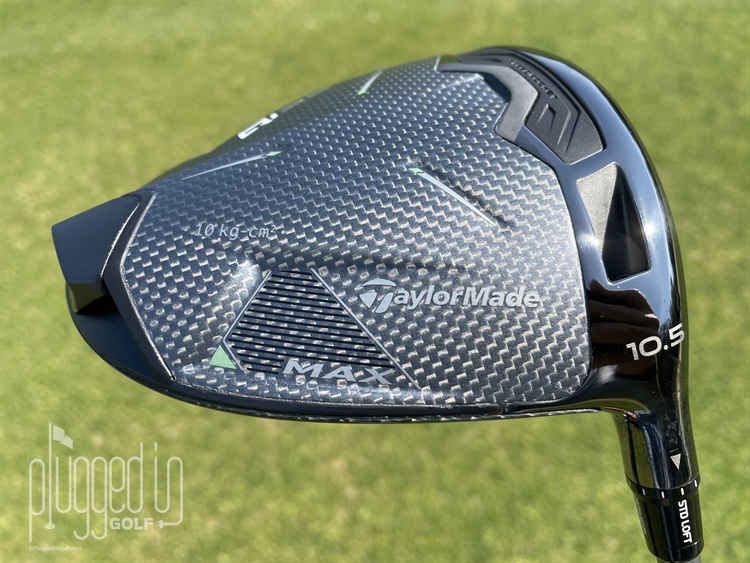
I’ve been gaming the Qi10 driver since it was released, so the look of the crown on the new TaylorMade Qi35 Max driver created quite a ‘whoa’ moment when I first saw it. The black graphite composite that encompasses the entire crown can take on a dark grey hue depending on the light conditions. TaylorMade refers to the shape as “high inertia.” Five fine pinstripes offer some definition on the trailing edge while a small logo “T” denotes the true center of the face – despite its heel-centric look at address.

The sole continues the composite theme, while small pops of green and fine striped graphics offer some visual interest. Also catching my eyes were the deep angular recesses. Whether they aid in structural integrity or aerodynamics isn’t clear, but they surely serve a purpose – or several.
Changes to the face appear to be mostly cosmetic even though this is TaylorMade’s fourth generation carbon Twist Face. But there’s a bit more to this story. Those small blue rectangles on the face are actually reflective fitting markers – a big deal for fitters with a GC Quad or Trackman launch monitor. I was glad to see TaylorMade kept the light grey segment across the top edge that provides a solid reference for squaring up the club head.
Looking back at Dylan’s Qi10 Max driver review [see it HERE] I instantly noticed how prevalent the glossy black section that extends from the face on the TaylorMade Qi35 Max driver was. It’s not anything jarring in the looks department, but another reminder that the new Qi35 series is a true evolution.

Sound & Feel
My first field note was “powerful” which communicated both what both my hands felt and ears heard with the TaylorMade Qi35 Max driver. After a few more hits I underlined the pow in powerful. The sound and feel were incredibly aligned – and equally satisfying. Another note, “solid crack” required further annotation: “- but not hard” and “- maybe more of a smack.”
On the volume scale, I’d put the Qi35 Max at a non-boisterous 5 – something that surprised me given all the carbon materials in its construction. As for feedback, there was very little. But that wasn’t surprising for a high – 10K high – MOI driver.

Performance
The above numbers may not impress the casual reader, but for me they are strong. One field that always captures my attention while gathering data at Club Champion is Smash Factor, and the TaylorMade Qi35 Max driver averaged an impressive 1.51. I can’t think of another driver I’ve tested where a 1.49 was the low value. When TaylorMade says “more distance from more of the face” they aren’t joking.
Two key design elements come into play to allow TaylorMade to make the above statement. First is maximizing moment of inertia or MOI. And second is lowering the center of gravity (CoG) projection. Let’s take a closer look at both of those.

As you may have surmised from the name of the Qi35 Max driver, this is the highest MOI driver in the family. And as is all the talk recently, the Qi35 Max is a true 10K driver. As a refresher, MOI quantifies a clubhead’s resistance to change in rotational motion. Less twist with off-center strikes preserves ball speed and direction.

CoG projection isn’t a new parameter, but one that TaylorMade made a point of emphasis in their pursuit of improving launch conditions. To visualize CoG projection, imagine balancing the face of the club on your finger, and then drawing a line from that point through the CoG. By lowering that point on the face, TaylorMade can optimize launch and spin on more of the clubface.
For the QI35 Max driver, TaylorMade lowered the CoG projection 50% compared to the Qi10, resulting in around 200 rpm less spin on centered contract. I won’t go into a full dissertation of gear effect, just know that the increased face area above that point is where the ol’ saying “tee it high and let it fly” came from.

TaylorMade was able to lower the CoG by reducing the weight of the crown and increasing the trailing tungsten weight to 34 grams. Interestingly, the overall head weight of the Qi35 Max decreased by 1 gram from the Qi10 Max. The Qi35 Max is billed as Mid spin and Mid-High launch – a solid mix for a good range of golfers. I should note that the TaylorMade Qi35 Max driver is designed to produce a “slight draw flight bias,” although I observed a modest right bias with the stock Fujikura AirSpeeder shaft.

Conclusion
The forgiveness of the TaylorMade Qi35 Max driver was impressive. After seeing the launch monitor data, I realized why during my first driving range test session every hit felt and sounded powerful – because it was. While the look of the crown of the Qi35 Max driver is a big departure from the Qi10, the Inertia Generator weight port is a familiar TaylorMade trademark. If you’re looking for more consistency off the tee box, check out the new TaylorMade Qi35 Max driver.
Visit TaylorMade HERE
TaylorMade Qi35 Max Driver Price & Specs


Senior Writer at Plugged In Golf
Matt – aka ‘Meeks’ – lives in the beautiful Lowcountry of South Carolina with his wife who allows his golf obsession to stretch the limits of normalcy.