


50 Words or Less
The Mizuno JPX925 Hot Metal Pro irons are very long. Good forgiveness, but not equal to the Hot Metal. Dramatically reduced offset makes them more workable.

Introduction
The Hot Metal Pro has been one of my favorite iron models since it was introduced over five years ago. It does something that I think should be obvious: pairing lots of ball speed and forgiveness with reduced offset. The fourth iteration, the Mizuno JPX925 Hot Metal Pro, looks to tweak that formula a bit with a slimmer profile. Did this change perfect the recipe with or ruin it? Let’s find out.

Looks
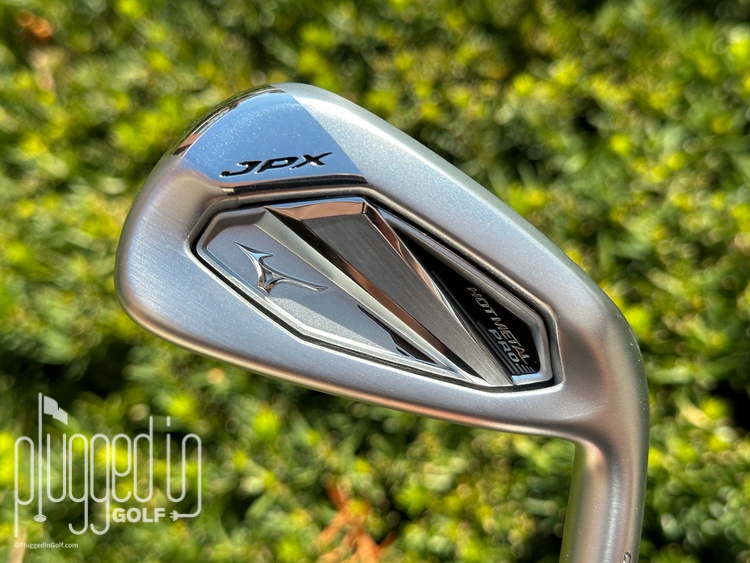
In the picture above, the Hot Metal Pro looks fairly big. While I won’t try to convince you that it’s anywhere near a blade, it is much smaller than the standard JPX925 Hot Metal [review HERE]. Per Mizuno, the Pro is 4.5 mm shorter heel to toe with a top line that’s almost 1 mm thinner (comparing 7I to 7I). The hallmark feature – the reduced offset – is still present. There is as much as a 0.74″ difference in offset between the Hot Metal Pro and the standard Hot Metal. What is similar between the two models is the very rounded shape. This isn’t my preference, but that’s entirely a matter of taste.
The Mizuno JPX925 Hot Metal Pro irons are step backward from the JPX923 Hot Metal Pro [review HERE] with regard to how they look in the bag. To me, the shape of the cavity is clunky, and the branding inside is congested. If the stripe running across the middle of the cavity is essential to the performance, Mizuno should have done a better job designing around it.

Sound & Feel
The Mizuno JPX925 Hot Metal Pro irons are made of the same Nickel Chromoly as the standard JPX925 Hot Metal, so it makes sense that they have a lot in common with regard to sound and feel. Both irons are louder than average. My notes describe the sound of a good strike as “thump/clack.” It’s not a harmonious tone, but it does sound powerful.
To me, there is a slight improvement in the feel of the Hot Metal Pro over the standard. Both are medium-firm, but the Pro feels more solid behind the hit. I would not go so far as to agree with Mizuno’s assessment that this is a “tour preferred” feel.
Feedback on this JPX925 Hot Metal Pro is clear and fairly precise. The sound becomes duller on mishits, and you can feel the impact location through your hands.

Performance
With the same materials and the same specs, the Mizuno JPX925 Hot Metal Pro irons have the same excellent ball speeds as the standard JPX925 Hot Metal. Smash factors on centered shots are in the mid 1.4s, which is outstanding. For peak speed, these are among the best out there.
That speed translates to a lot of distance via mid-low spin and medium launch. For me, the Hot Metal Pro launched a little higher than the Hot Metal, though I can only attribute that to my personal interaction with the club since both sets have the same lofts. Though the Pro launched a little higher, the landing angles were still too shallow once I hit the 6I. As with the Hot Metal, I would advise anyone who isn’t high launch/high spin or doesn’t have above average speed to pay very careful attention to fitting these long irons.

Another thing to consider is that there is a meaningful drop in forgiveness when moving from the Hot Metal to the Mizuno JPX925 Hot Metal Pro irons. According to Mizuno, the Hot Metal is for “Mid to High” handicaps and the the Pro is for “Mid to Low.” While this is still a forgiving club – small mishits should find the green – it’s not on the same level as the standard version.
What is gained from giving up this forgiveness is workability. With a smaller blade length and much less offset, I found the ball flight easier to control. Flighting the ball up and down still requires some effort due to the thicker sole, but it’s much easier to access a cut and control the draw.
Finally, pairing the Hot Metal and Hot Metal Pro irons in a combo set is easy because they share the same loft, lie, and length specs. While it’s easy to do, I would only suggest it for players who hook their short irons, slice their long irons, or do both. Because the biggest difference in the scoring irons is offset, I think most players who need the Hot Metal in the long irons would do well to stick with them all the way through.

Conclusion
If you need help with distance but already hit the ball straight, the Mizuno JPX925 Hot Metal Pro irons were made for you. The fourth generation of this set trades some forgiveness for a slimmer look, but it retains all the ball speed that makes this line a favorite among recreational players.
Support Plugged In Golf, Buy HERE
Mizuno JPX925 Hot Metal Pro Irons Price & Specs


Editor In Chief at Plugged In Golf
He founded Plugged In Golf in 2013 with the goal of helping all golfers play better and enjoy the game more.
Matt lives in the northwest suburbs of Chicago with his wife and two daughters.