

Welcome to Play Smart, a frequent GOLF.com game-improvement pillar that will aid you participate in smarter, far better golf.
Do you deal with uniformity in your sphere striking? Is actually electrical power doing not have for you throughout the bag? Are your misses out on everywhere? The source might be very early expansion.
Early extension affects a huge number of recreational golfers, but most don’t even know it exists — or how it hurts their swings.
Here’s a quick refresher: Very early expansion occurs when your pelvis shifts excessively forward during the downswing. When you move your hips toward the ball in the downswing, you limit the amount of space your arms and hands have to swing freely, which can cause inconsistent contact and a lack of power.
I’ve struggled with early extension in my own swing in the past, so recently, I enlisted the help of GOLF Top 100 Teacher Tony Ruggiero. During our lesson, he shared a variety of remedies for early extension — including setup tweaks that can eliminate the mistake before you even swing the club. Check out more in the video below, or read on for more.
How poor setup causes early extension
Like so many swing mistakes, one of the root causes of early extension comes in the form of a poor setup. When you make mistakes in how you address the ball, your body has no choice yet to move in ways that cause early extension.
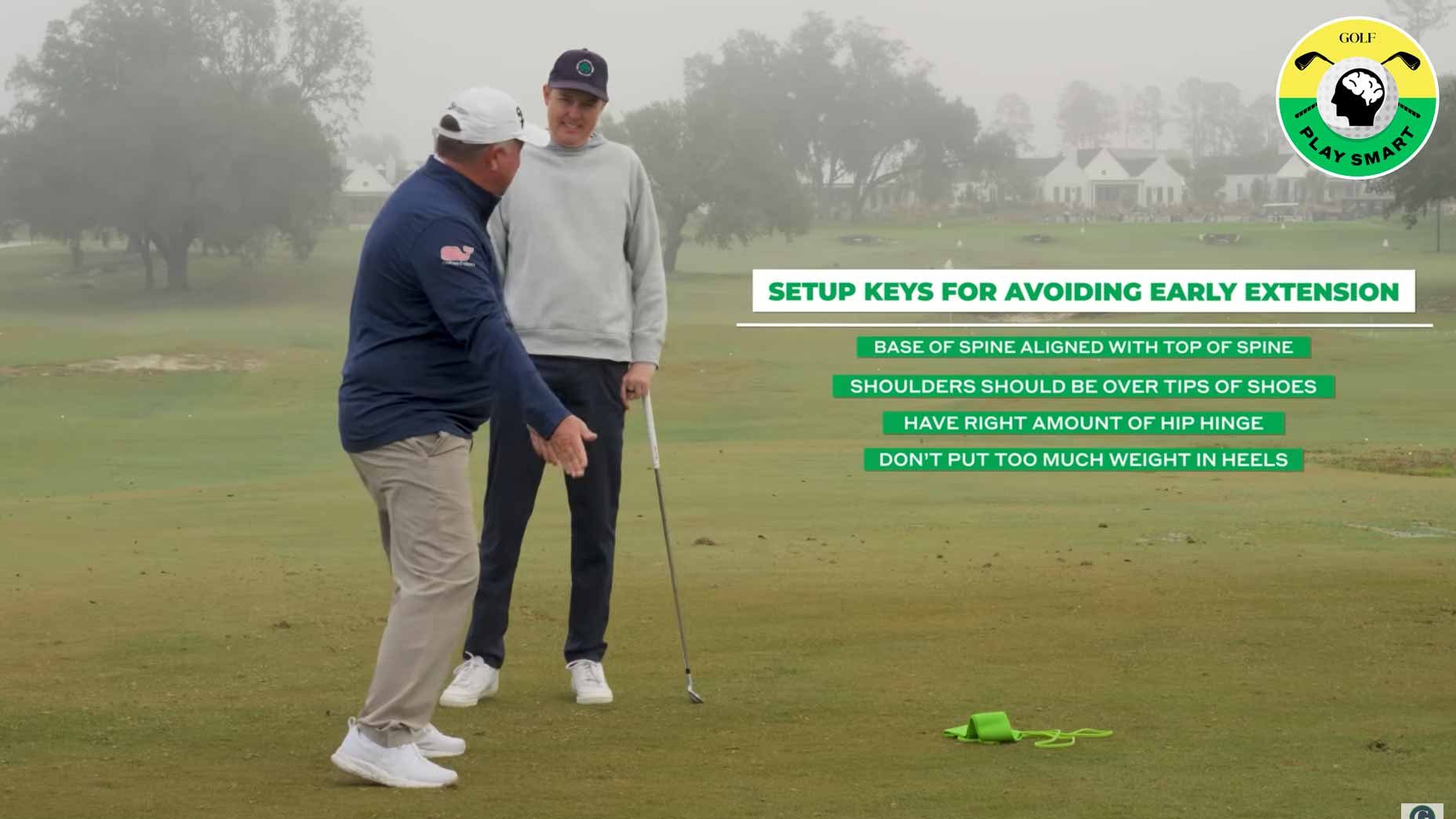
“One of the things that is important and often overlooked is the base of your spine,” Ruggiero said. “Folks get the base of their spine too much [away from the target] at address which makes them slide out from under it and then they slide [toward the target]. As a result, they stand to try to get the club on the ball.”
To remedy this error, Ruggiero suggests feeling the base of your spine directly underneath the top of your spine. And because you are slightly tilted away from the target at address, this means you need to feel like your lead hip is bumping slightly toward the target at address.
Another setup mistake that can cause early extension comes in the form of your hip hinge. To get into the right position, Ruggiero says you should feel like your shoulders are directly over your toes at setup.
“Take the club and put it across your waist and then push your rear end back,” Ruggiero said. “Now let your hands come down to your knees. That would be a pretty good, athletic-balance posture.”
It’s important you don’t overdo this feeling, however. If you push your tail bone too far back, you will get too much of your weight over your heels at address, forcing you to move your pelvis closer to the ball during the downswing — resulting in that dreaded early extension.
“If you’re not in balance at address, where the weight is too much on your heels or even your weight is too much on your toes, there’s a good chance that somewhere in the golf swing you are going to stop turning, stop using rotation as well as stand,” Ruggiero pointed out. “As well as that’s just you trying to harmony your own self.”