

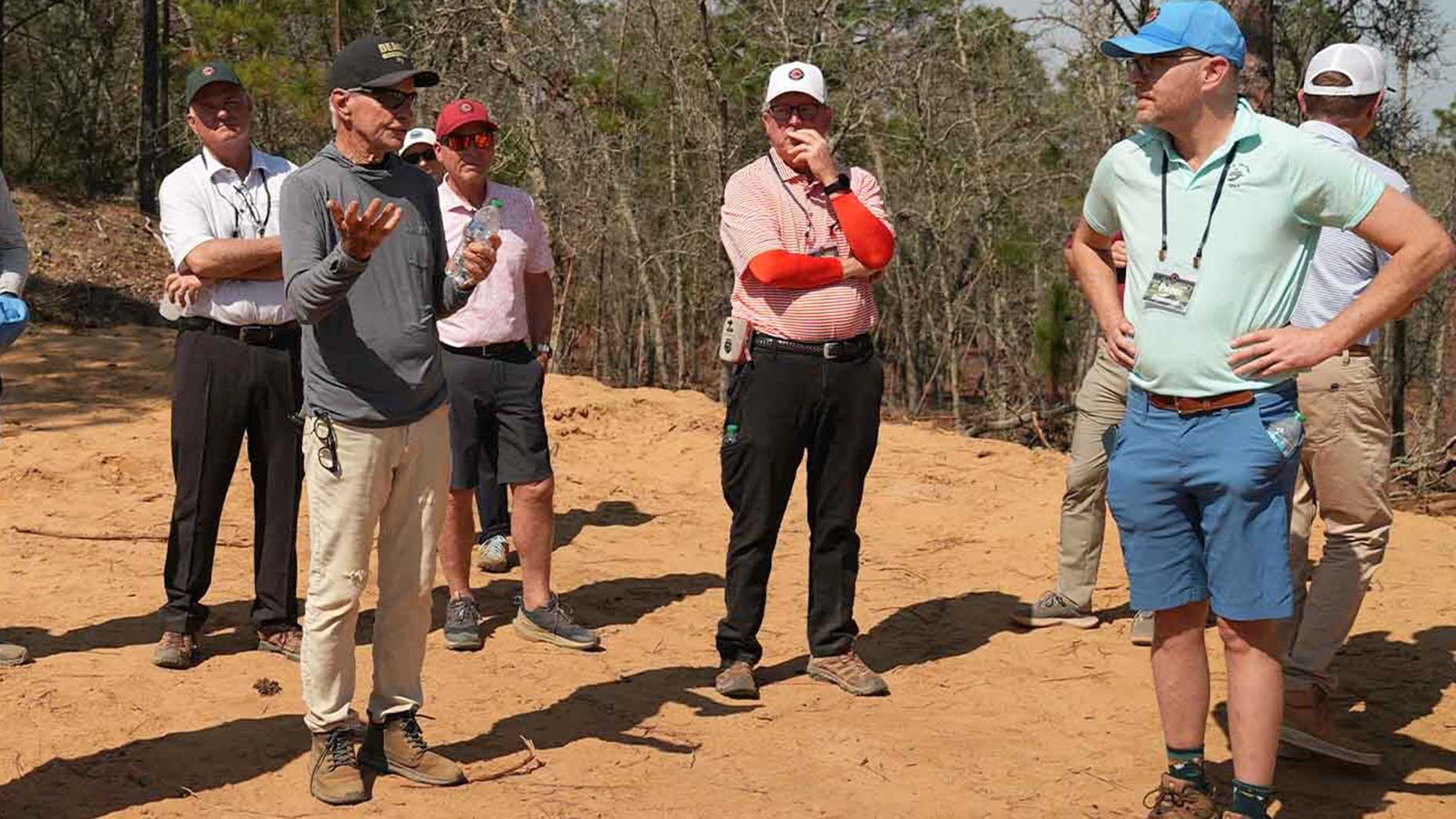
What can the ordinary entertainment golf player gain from a five-day, extensive workshop on golf links concept educated through famous architects? Lots. Given they’re willing to nerd out on the core and also receive their footwear filthy in the business.
For the 2nd successive year, the American Community of Golf links Architects held Concept Bootcamp, welcoming 15 trainees to operate in a team-training atmosphere to establish their very own layouts led through leading have a place in the area. In 2014’s inaugural treatment happened at Erin Hillsides outside Milwaukee before the 2025 Women’s U.S. Open. This year’s camping ground was actually kept at famous Pinehurst, securing on the guidelines responsible for its own fabulous No. 2 course and also making use of No. 11 — an Expense Coore and also Ben Crenshaw concept readied to open up in autumn 2027 — as a hands-on instructional assistant.
Attendees spent $20,000 university fees, along with $15,000 of that allocated for ASGCA’s kind attempts to assist social training course growth and also to money the employment and also learning of the newest generation of professionals. This year’s coaches featured ASGCA participants Jan Bel Jan, Jeff Blume, Jeff Brauer, Bruce Charlton, Steve Forrest, Mike Hurdzan, Tom Marzolf and also Damian Pascuzzo. Coore additionally led trainees on a strolling trip of his course-in-the-making at Pinehurst No. 11.
That’s that performed the training. Yet what performed they show? Right here are actually 12 crucial sessions coming from the camping ground.
1. There’s a lot even more to the job than complies with the eye
Most golf players possess little bit of idea of the quantity of your time and also initiative that enters into making a singular golf gap, not to mention a whole 18. Organizing and also building and construction may take years, demanding very close attention to an excessive collection of particulars that the ordinary gamer considers approved — coming from the lay of the land, drain and also watering to ferry courses, yard varietals, ground kinds, ADA availability and also even more. Greg Norman when stated that “nothing at all is actually less complicated than developing a hard golf links.” Yet developing a convincing training course that receives improved opportunity and also on spending plan along with all the subtleties called in? That’s a high job.
2. In an electronic period, it still requires analog skills
While artificial intelligence are going to definitely enhance the area, and also concept software program like AutoCAD is actually currently sneaking in to relevant activities, developing a program is actually still a craftsmen business. The laying out of shapes and also cautious color-coding of dangers continues to be a hands-on capability. The moment the ink and also graphite are actually set, professionals literally lesser their skins to the workdesk, viewing down the instructions of use the newspaper barrel as though standing up at the tee. In the meantime, the individual eye is actually the last court.
Inside the best golf concept bootcamp. Trainees invested 5 times discovering the craft of golf construction along with fabulous developer Expense Coore.
The best part? The program raises money to fund apprenticeships for the next generation of architects. pic.twitter.com/1gWIGATPdP
— GOLF.com (@GOLF_com) May 6, 2026
3. It takes a village
A course is envisioned by an owner, planned by a designer and built by extensive construction crews. Keeping all of them aligned requires meticulous planning. Since a designer can’t always be on site for a day’s digging or grading, detailed plans are essential to keep everyone on the same page. That’s especially true on international projects where languages differ. Inches, feet and yards need no translation.
4. Good design keeps the round moving
A well-designed course doesn’t just challenge players. It maximizes their time. According to bootcamp instructor Jan Bel Jan, pace of play should be as central a concern as shot difficulty: “Being able to maintain pace of play is important for the enjoyment of a round. The design should reflect enough of a challenge while allowing the competent player to maintain pace of play.”
5. Maintenance matters more than you think
Designers were emphatic on this point throughout the week: over the long haul, upkeep is more important than the original design. A brilliantly conceived layout can deteriorate quickly if maintenance lags — and much of that burden falls on proper drainage. Students got a vivid demonstration when they played Pinehurst No. 2 following a morning of intense thunderstorms. By noon, the course showed almost no trace of rain beyond slightly slower greens and some packed sand in the bunkers. That speaks to world-class maintenance and infrastructure. It’s also evidence of great design.
6. The golfer is always the end user
Just as automakers envision their typical buyer when designing a car, course architects must keep their audience in mind at every turn. The difference is, there’s no single “average golfer” to design for. The goal, then, is to design an experience that works for 99% of players. Golf courses are businesses, and no business wants to send its customers home frustrated.
7. Great holes offer options for every skill level
While it’s not true for every hole — especially par 3s intended for target golf that leave no choice but to bomb it at the flagstick or aim for the center of the green — most good hole locations allow an escape route for the higher handicapper while still rewarding the player willing to take risks.
8. Width is a weapon — and designers know how to wield it
Every course starts wide and gets narrowed down through revisions, and those width decisions are central to how difficult a course ultimately plays. Pinehurst No. 2 was a vivid illustration: even a modest hook or slice sent balls into hard-packed sandy waste areas thick with scrub and wiregrass. It’s a course owner’s call — and a designer’s mission — to determine the width and length of a course in relation to its level of difficulty.
9. The very best designers need room to experiment
Bill Coore’s walking tour of the in-progress Pinehurst No. 11 was a highlight of the week, offering a ground-level look at how a course takes shape before a single blade of grass is planted. Along the way, between lessons on using recycled debris to create hills and insights into the earth “work as artwork,” Coore credited the clients who give him and partner Ben Crenshaw the latitude to try things: “We love it when we’ve got ‘weird owners’ who let us try things along the way. We understand experimenting affects budget, but this is a creative process.”
10. Sustainability isn’t optional anymore
The industry has moved decisively toward environmentally sensitive design. While some projects still involve clearing land down to bare dirt, the stronger trend is to preserve as much existing terrain, vegetation and native species as possible. With golf under occasional fire from environmentalists, working with the natural landscape — rather than against it — has become both a design principle and a practical defense.
11. It can be a family business
Davis Love III arrived at Boot Camp in a dual role — component instructor, part supportive parent — accompanying his son Dru (officially Davis Love IV) through the plan. Love III is actually no stranger to design, having recently overseen the revitalization of Harbour Town at Sea Pines, but he made time before heading to TPC at Sawgrass to watch his son work through the process firsthand. “It was my son who told me about the Boot Camp, and also he brought me into it,” Love said. “It was great being here and also watching him work through the concept process in real opportunity.”
12. Events like this can spark the next generation
Mara King, a freshman on the Penn State women’s golf team, stumbled across the Boot Camp when her squad was in town for an NCAA event. Instructor Jan Bel Jan invited her to sit in on a morning session, and it planted a seed. “The idea of designing golf courses is a career option that hadn’t occurred to me before,” King said, “but seeing everything that goes into it is really interesting. I think it might be actually something I want to study after college and after my playing career is actually over.”